
First Reading
(track one)
Genesis 21:8–21
And the child grew and was weaned. And Abraham made a great feast on the day that Isaac was weaned. But Sarah saw the son of Hagar the Egyptian, whom she had borne to Abraham, laughing. So she said to Abraham, “Cast out this slave woman with her son, for the son of this slave woman shall not be heir with my son Isaac.” And the thing was very displeasing to Abraham on account of his son. But God said to Abraham, “Be not displeased because of the boy and because of your slave woman. Whatever Sarah says to you, do as she tells you, for through Isaac shall your offspring be named. And I will make a nation of the son of the slave woman also, because he is your offspring.” So Abraham rose early in the morning and took bread and a skin of water and gave it to Hagar, putting it on her shoulder, along with the child, and sent her away. And she departed and wandered in the wilderness of Beersheba.
When the water in the skin was gone, she put the child under one of the bushes. Then she went and sat down opposite him a good way off, about the distance of a bowshot, for she said, “Let me not look on the death of the child.” And as she sat opposite him, she lifted up her voice and wept. And God heard the voice of the boy, and the angel of God called to Hagar from heaven and said to her, “What troubles you, Hagar? Fear not, for God has heard the voice of the boy where he is. Up! Lift up the boy, and hold him fast with your hand, for I will make him into a great nation.” Then God opened her eyes, and she saw a well of water. And she went and filled the skin with water and gave the boy a drink. And God was with the boy, and he grew up. He lived in the wilderness and became an expert with the bow. He lived in the wilderness of Paran, and his mother took a wife for him from the land of Egypt. (ESV)
(track two)
Jeremiah 20:7–13
	O LORD, you have deceived me,
		and I was deceived;
	you are stronger than I,
		and you have prevailed.
	I have become a laughingstock all the day;
		everyone mocks me.
	For whenever I speak, I cry out,
		I shout, “Violence and destruction!”
	For the word of the LORD has become for me
		a reproach and derision all day long.
	If I say, “I will not mention him,
		or speak any more in his name,”
	there is in my heart as it were a burning fire
		shut up in my bones,
	and I am weary with holding it in,
		and I cannot.
	For I hear many whispering.
		Terror is on every side!
	“Denounce him! Let us denounce him!”
		say all my close friends,
		watching for my fall.
	“Perhaps he will be deceived;
		then we can overcome him
		and take our revenge on him.”
	But the LORD is with me as a dread warrior;
		therefore my persecutors will stumble;
		they will not overcome me.
	They will be greatly shamed,
		for they will not succeed.
	Their eternal dishonor
		will never be forgotten.
	O LORD of hosts, who tests the righteous,
		who sees the heart and the mind,
	let me see your vengeance upon them,
		for to you have I committed my cause.

	Sing to the LORD;
		praise the LORD!
	For he has delivered the life of the needy
		from the hand of evildoers. (ESV)
Second Reading
Romans 6:1b–11
Are we to continue in sin that grace may abound? By no means! How can we who died to sin still live in it? Do you not know that all of us who have been baptized into Christ Jesus were baptized into his death? We were buried therefore with him by baptism into death, in order that, just as Christ was raised from the dead by the glory of the Father, we too might walk in newness of life.
For if we have been united with him in a death like his, we shall certainly be united with him in a resurrection like his. We know that our old self was crucified with him in order that the body of sin might be brought to nothing, so that we would no longer be enslaved to sin. For one who has died has been set free from sin. Now if we have died with Christ, we believe that we will also live with him. We know that Christ, being raised from the dead, will never die again; death no longer has dominion over him. For the death he died he died to sin, once for all, but the life he lives he lives to God. So you also must consider yourselves dead to sin and alive to God in Christ Jesus. (ESV)
Gospel Text
Matthew 10:24–39
“A disciple is not above his teacher, nor a servant above his master. It is enough for the disciple to be like his teacher, and the servant like his master. If they have called the master of the house Beelzebul, how much more will they malign those of his household.
“So have no fear of them, for nothing is covered that will not be revealed, or hidden that will not be known. What I tell you in the dark, say in the light, and what you hear whispered, proclaim on the housetops. And do not fear those who kill the body but cannot kill the soul. Rather fear him who can destroy both soul and body in hell. Are not two sparrows sold for a penny? And not one of them will fall to the ground apart from your Father. But even the hairs of your head are all numbered. Fear not, therefore; you are of more value than many sparrows. So everyone who acknowledges me before men, I also will acknowledge before my Father who is in heaven, but whoever denies me before men, I also will deny before my Father who is in heaven.
“Do not think that I have come to bring peace to the earth. I have not come to bring peace, but a sword. For I have come to set a man against his father, and a daughter against her mother, and a daughter-in-law against her mother-in-law. And a person’s enemies will be those of his own household. Whoever loves father or mother more than me is not worthy of me, and whoever loves son or daughter more than me is not worthy of me. And whoever does not take his cross and follow me is not worthy of me. Whoever finds his life will lose it, and whoever loses his life for my sake will find it. (ESV)
Comments and Questions for Discussion
First Reading
(Genesis, track one)
While I was doing some research for this lesson from Genesis, I came across an article that helped me view the story of Hagar and Ishmael in an entirely new light. Some of you reading this may think “Oh, how did you not see this before?” when I tell you what I found, but it’s new to me, so I’m putting it here!
Did you realize how many parallels there are between this story and the one we’ll read next week from Genesis? The story of Abraham’s near sacrifice of Isaac (in many circles known as the Aqedah)? The author of the article that I discovered has set this sad tale of Hagar and her young son alongside other texts of mothers and their sons in the Hebrew Scriptures and drawn out some meaningful relationships. While not all of the parallels are contained within the lectionary for this week or next, I’m going to show them all here, as best I can.
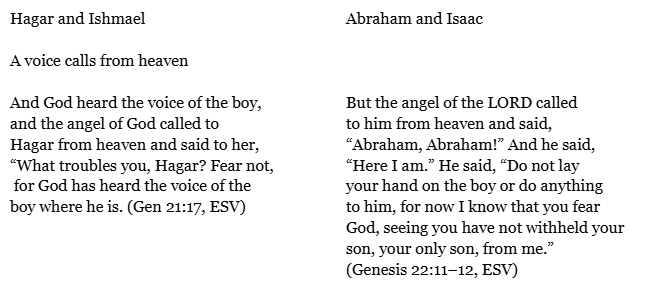
There is a journey with symbols. The wood and the fire are more obvious in the case of Abraham and Isaac, but the meager supplies, a skin of water and a little bread, are equally symbolic of the death that Hagar and Ishmael face in the wilderness.
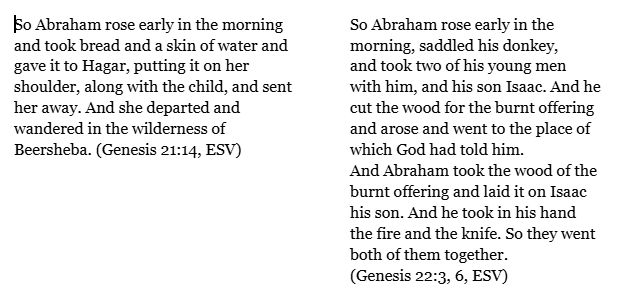
There are other, more esoteric parallels, but those suffice to illustrate the similarities. In his book, “The Death and Resurrection of the Beloved Son” Jon Levenson goes on to demonstrate the way that this theme echoes throughout the Bible, in Ishmael, Isaac, Jacob, Joseph, and Jesus. No, I haven’t read it, but I probably will, now. I’ll get into this theme and it’s relationship to Abraham as Paul views him next week, when we actually read the Aqedah.
For the time being, it’s worth noting the way that Hagar is transformed from Sarah’s antagonist to the protagonist of this passage. How does her similarity to Abraham affect how you read these words now?
Jeremiah
(track two)
Our reading this week from Track Two comprises the first half of what is generally known as the last of Jeremiah’s “confessions.” In the book of the same name there are four “confessions” in which is has been popularly thought that the prophet complains to God about the cost of being Their prophet, of speaking the word(s) of the Lord to a reluctant people.
While in recent decades some questions have been raised as to this confessional/personal reading of the four passages (Jeremiah 11:18-12:6; 15:10-21; 17:5-18; 20:7-18). It has been suggested that these texts bear too close a relationship to the complaints of some of the psalms to be taken as personal. It has also been said that the “I” of Jeremiah’s laments refers more to the Judahites among whom the prophet lives than the prophet himself.
While these readings may have some merit, they do seem to overlook the intensely personal nature of the texts and the way that they are paralleled in Jeremiah’s own life experience. For me, these alternatives are a good correction against reading the “confessions” with too great a confidence in our interpretation, but they don’t convince me yet to change my own.
In keeping with this personal reading of this last confession, I would like to share what I learned in my studies this week.
In the first, larger study of the fourth confession, the article I read points out that in it can be found two self-contained, concentric sections. I cannot go into the details, so I commend the article to your reading if you would like more (Jeremiah’s Last Confession). I’ll give you, though a thumbnail of the structures of those sections.
In the first section we find:
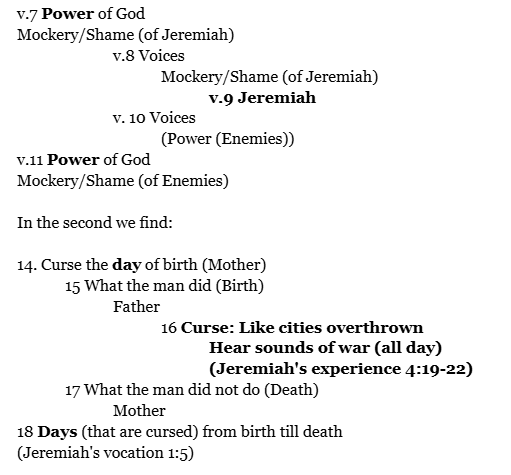
What this reveals in the larger structure of the confession is this:
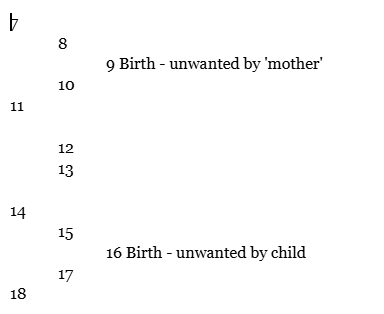
The unity and the structure of this lament convince me that the prophet does indeed refer to himself. And in our reading the central verse must be the center of the concentric section, verse nine.
	If I say, “I will not mention him,
		or speak any more in his name,”
	there is in my heart as it were a burning fire
		shut up in my bones,
	and I am weary with holding it in,
		and I cannot.
Here I shift to the second interesting study of this passage that I came across. In this one, the author points to the “burning fire,” which might also be translated “consuming fire.” And in it, the prophet may be making a reference to a fire that did not consume. That is, the burning bush. In the passage from Genesis, the bush “was not consumed.” Which might just as easily be translated “was not eaten.”
This resonates with the many passages of Scripture in which God’s word is something “eaten.” In Jeremiah’s experience, though, the word he has been given to preach is not something he consumes, but something that consumes him. He has tried to contain this fire that consumes, but he cannot, quite the opposite of the first of the great prophets, Moses.
Whether or not one agrees that Jeremiah intended a parallel (or perhaps an inverse parallel?) to Moses, it is clear that he found the word he’d been given to preach something “consuming.” How does that speak to our experience of speaking God’s word to a world in crisis?
Second Reading
In our reading from Paul for this week we have the first half of a conundrum. The difficulty this passage presents are obscured by the fact that our lectionary leaves off verses 12-14, which are a part of this unit of Romans that it really can’t do without. So I’m going to put the whole of Romans 6:1-14 here, with the parts omitted by the lectionary in italics.
Romans 6:1–14
What shall we say then? Are we to continue in sin that grace may abound? By no means! How can we who died to sin still live in it? Do you not know that all of us who have been baptized into Christ Jesus were baptized into his death? We were buried therefore with him by baptism into death, in order that, just as Christ was raised from the dead by the glory of the Father, we too might walk in newness of life.
For if we have been united with him in a death like his, we shall certainly be united with him in a resurrection like his. We know that our old self was crucified with him in order that the body of sin might be brought to nothing, so that we would no longer be enslaved to sin. For one who has died has been set free from sin. Now if we have died with Christ, we believe that we will also live with him. We know that Christ, being raised from the dead, will never die again; death no longer has dominion over him. For the death he died he died to sin, once for all, but the life he lives he lives to God. So you also must consider yourselves dead to sin and alive to God in Christ Jesus.
Let not sin therefore reign in your mortal body, to make you obey its passions. Do not present your members to sin as instruments for unrighteousness, but present yourselves to God as those who have been brought from death to life, and your members to God as instruments for righteousness. For sin will have no dominion over you, since you are not under law but under grace. (ESV)
Commentators on this part of chapter 6 of Romans struggle to make sense of it because of the way that Paul shifts his verbs from the indicative mood in the first section (what we have for Sunday) to the imperative mood in vv. 12-14 (with a hint of the imperative in v. 11). To make that plainer, Pauls shifts from saying:
“We know that our old self was crucified with him in order that the body of sin might be brought to nothing, so that we would no longer be enslaved to sin.” That is, these things are already true, this is a real thing, indicative mood for the verb, to:
“Let not sin therefore reign in your mortal body, to make you obey its passions.” That is, our body of sin hasn’t really been brought to nothing, there is something left to do (imperative mood).
How are we to reconcile those two things? As one author put it, the first approach on its own leads to a kind of laziness, a “God does it all” attitude. The second leads to legalism. How can they both be real, both be true?
It seems to be that it is absolutely necessary that both be true and held in tension. Either without the other veers away from a Gospel that has any real power. The first approach, that which we’ll actually read on Sunday, leads to a complacency that fails to bring growth. The second fails because it rests not on what God has done, but on what we do.
So, it is true that we have died with Christ and made alive to God. But it remains true that we have yet to align our lives fully with that truth. How do we get our lives to align with that truth without falling into legalism? Through the renewing of our minds.
Do not be conformed to this world, but be transformed by the renewal of your mind, that by testing you may discern what is the will of God, what is good and acceptable and perfect. (Romans 12:2, ESV)
And how does Paul envision this transformation of our minds happening?
And we all, with unveiled face, beholding the glory of the Lord, are being transformed into the same image from one degree of glory to another. For this comes from the Lord who is the Spirit. (2 Corinthians 3:18, ESV)
By beholding the glory of the Lord, looking upon Him face to face. Which we can do because:
We were buried therefore with him by baptism into death, in order that, just as Christ was raised from the dead by the glory of the Father, we too might walk in newness of life. (Romans 6:4, ESV)
The truth of our redemption draws us into a new way of living, which we work for by looking into the glory of the One who redeemed us, which we can only do because of the truth of our redemption. To me it’s rather circular. And wonderful.
Gospel Text
In this week’s reading from Matthew Jesus draws near to the close of His speech to the twelve before sending them out to do deeds of power and preach the Kingdom of God. And in the midst of this passage we hear these words, “And do not fear those who kill the body but cannot kill the soul. Rather fear him who can destroy both soul and body in hell.”
All too often when I find myself in conversations with Christians who call themselves “conservative evangelical” these words pop up at one point or another when I try to explain to them that I don’t believe God wants me (or anyone else) to live in fear of hell. I will admit that there are times I wish Jesus had found another way to say this, because I still don’t believe that He wants me to live in fear of my soul being destroyed in hell.
It does little good to remind myself that in this case “fear” is more akin to “being in awe” than to being afraid. It is certainly not true that Satan is able to destroy my soul in “Gehenna” (the word translated “hell” here). So I’m not to be afraid of him.
I need to get a handle on this “fear.” And I have one.
As I was praying one day a number of years ago, I’d been wrestling with the idea of God’s wrath. (I think I’ve mentioned this somewhere else in the Divergences.) I was uncomfortable with the way that wrath is tossed around by some Christians as a threat, and yet I was uncomfortable with the way many Christians just avoid the topic or write it off as unimportant. So I was praying for understanding and in the midst of that prayer God opened a door for me. Just a tiny fraction. An inch. Maybe less. And through that tiny gap I glimpsed His wrath. Incandescent. It burned brighter and hotter than the sun, and it made me afraid. Not scared so that I shrank away from it (He only left it open a moment, all that I could bear.) but it was terrible. And wonderful. Reflecting on that revelation in the moments afterward I was first overwhelmingly thankful for the vision, and then I became aware that God’s love for me and His wrath against all unrighteousness were one and the same. His love for me is so fierce that it vaporizes anything between Him and me that it touches.
So I have an understanding of the “fear of God” that is terrifying even as it fills me with courage. And isn’t that what Jesus sought in the twelve to whom He spoke? Courage? I know who my God is and what there is to fear in Him. And because of that I have no reason to fear at all.
For a more easily printable version of this Divergence, please CLICK HERE.